
The role of water balance in surface electrochemistry and the physics of polymer interfaces
Abstract
In modern protective coating technologies, water is traditionally viewed as an auxiliary process agent, acting as a solvent, rinsing medium, or coolant. However, data from experimental corrosion science, surface electrochemistry, and the physical chemistry of polymers indicate that water is an active chemical component directly determining the adhesive strength of a coating, resistance to subfilm corrosion, and the durability of protective systems as a whole. This article provides a review of current scientific understanding of the role of water in metal pretreatment processes, analyzes the mechanisms of osmotic blistering, filiform and pitting corrosion, and substantiates the need for precise control of the ionic composition of process water as a key parameter for coating stability under long-term operating conditions.
1. Introduction: Rethinking the Role of Water in Coatings Technology
In the history of paint and powder coatings, the aqueous surface preparation stage was long perceived as technically neutral and secondary to the chemistry of conversion layers or the formulation of polymer systems. This approach was justified given the relatively short product life cycles and limited durability requirements. Modern operational realities have fundamentally changed this paradigm. Architectural façade systems, transportation infrastructure, energy, and industrial equipment are designed for decades of operation in aggressive climatic and industrial environments. Under these conditions, even minor defects introduced early in the process chain become cumulative and lead to premature failure of protective systems. A combination of laboratory and field studies shows that the vast majority of adhesive failures and cases of underfilm corrosion occurs not during the coating application or curing stage, but rather during the aqueous surface preparation process. Thus, water is no longer a passive participant in the process and should be considered a fully-fledged chemical factor influencing the thermodynamics and kinetics of interfacial interactions.
2. Physicochemical Nature of Process Water
2.1. Water as a Multicomponent Electrolyte System
From a physical chemistry perspective, any natural or industrial water is a complex multicomponent system comprising dissolved inorganic salts, organic compounds, gases, and biological components. Even water that meets drinking water quality standards contains ions capable of actively participating in electrochemical processes on the metal surface. Calcium and magnesium cations, typical for hard water, can form poorly soluble compounds and affect the morphology of conversion layers. Chloride and sulfate anions, being highly mobile, significantly increase the corrosive activity of the environment. Dissolved oxygen and carbon dioxide participate in the formation of localized galvanic couples, and organic impurities can be adsorbed on the metal surface, altering its surface energy.
2.2. Total Dissolved Minerals as an Integral Risk Indicator
Total Dissolved Minerals (TDS) is widely used as an integral characteristic of water quality. In the context of coating technologies, it is particularly important because it is directly related to the likelihood of salt deposits on the metal surface.
When water evaporates during the drying process, dissolved substances are not removed, but rather concentrate and crystallize on the surface or in the micropores of the conversion layer. These salt residues, often invisible to visual inspection, form a latent defect that only becomes apparent during the product’s operational phase. Experimental data show that when a certain TDS threshold is exceeded, the likelihood of osmotic and corrosion defects increases nonlinearly, indicating the critical nature of this parameter.
3. Polymer Coating as a Functional Membrane
3.1. Diffusion Properties of Polymer Films
Modern protective coatings are crosslinked polymer systems with a developed microstructure. Despite their high density and mechanical strength, such coatings are not completely hermetic. From a membrane physics perspective, they are classified as semipermeable media, capable of transmitting water molecules, oxygen, and low-molecular-weight ions. The diffusion rate is determined by a number of factors, including the chemical nature of the polymer, the degree of cross-linking, the presence of microdefects, and operating conditions. Even in the absence of visible damage, the coating gradually interacts with the environment, making the condition of the metal-coating interface critically important.
3.2. Osmotic Pressure as a Mechanism of Adhesion Failure
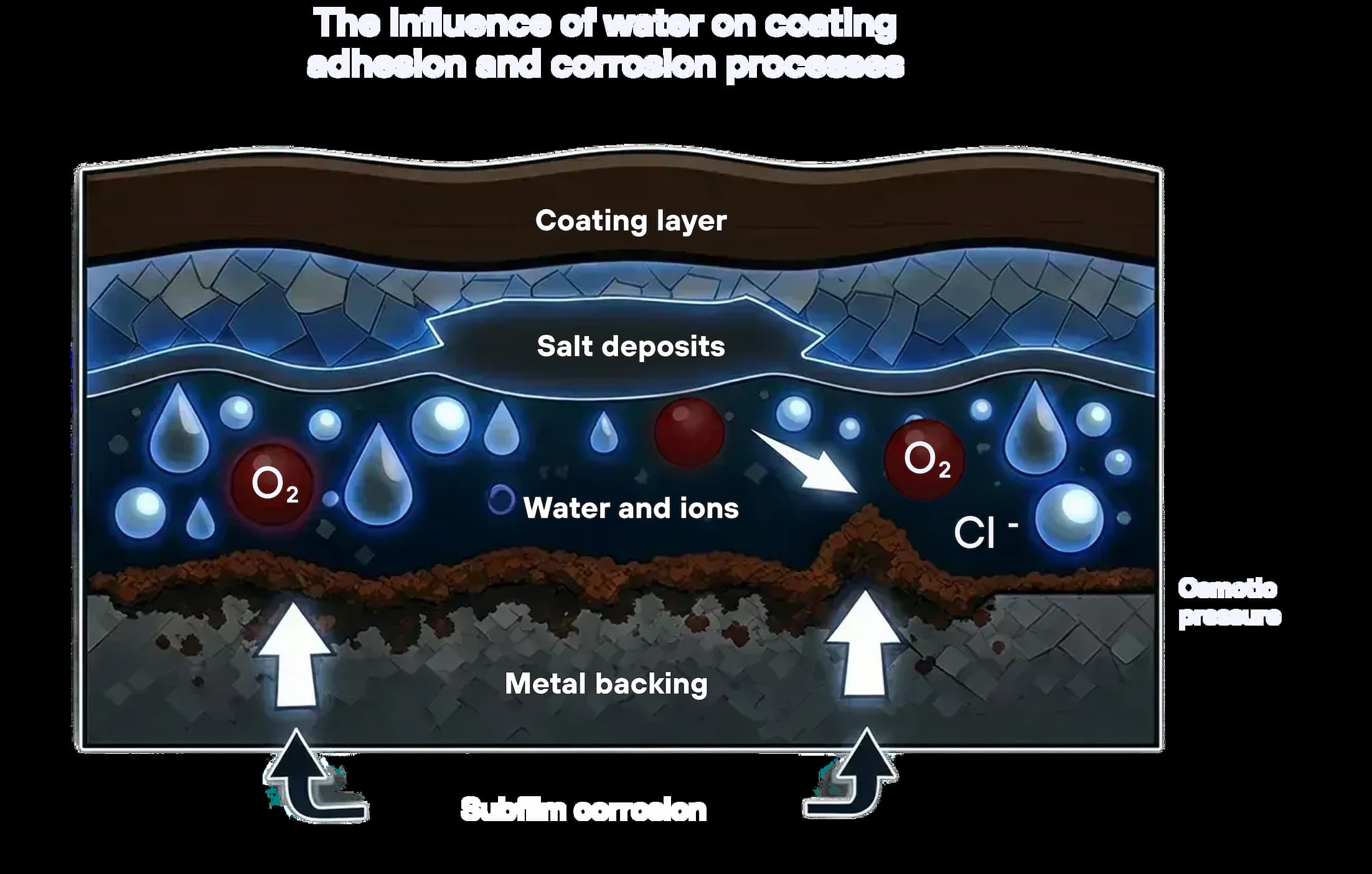
If soluble salts are present under the coating, an osmotic system is formed in which the polymer film acts as a membrane. The concentration difference between the subfilm zone and the external environment leads to a directed transport of water into the system. The resulting osmotic pressure can reach significant values, sufficient to rupture adhesive bonds at the molecular level. This results in the formation of blisters, microcracks, and localized delamination zones, which become foci for further corrosion degradation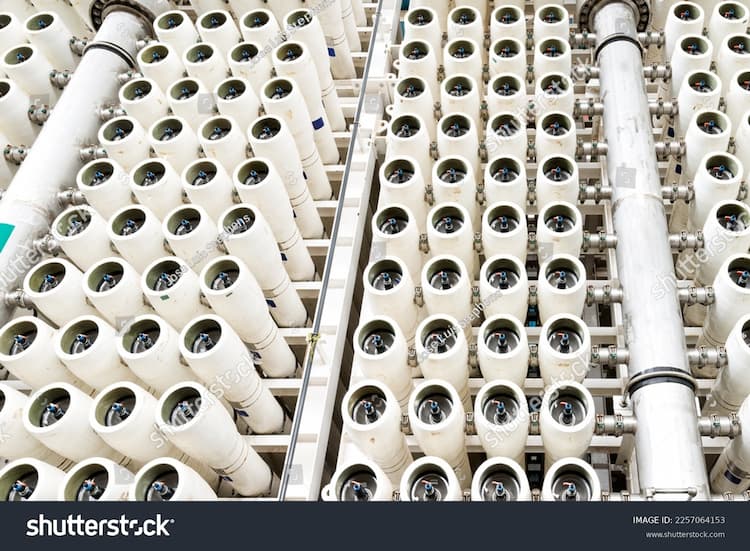
4. Underfilm Corrosion: Nature and Manifestations
4.1. Pitting Corrosion and the Role of Ionic Contamination
Pitting corrosion is one of the most dangerous forms of metal degradation under protective coatings, as it develops locally and often goes unnoticed until a critical stage. Chloride anions play a key role in this process, destroying passive oxide films and initiating localized anodic sites. Even low chloride concentrations present in residual moisture can significantly reduce the corrosion resistance of the system, especially under conditions of high humidity and temperature.
4.2. Filiform Corrosion as an Indicator of Water Defects
Filiform corrosion is typical for aluminum and galvanized substrates and is closely related to the presence of residual moisture and soluble salts on the surface. Its development almost always indicates a problem with the water treatment system, since, even with an identical coating formulation, it is the water quality that determines the rate and intensity of this process.
5. The Effect of Water on Conversion Layer Formation
Modern conversion technologies, including chromate-free systems, are highly sensitive to the ionic composition of water. The presence of calcium, magnesium, and organic impurities can disrupt the uniformity of conversion layer deposition, reduce its density, and impair adhesion properties. Furthermore, instability in the water balance leads to variability in surface parameters, making accelerated corrosion test results difficult to reproduce.
6. Precision Water Treatment as an Element of Engineering Culture
A modern scientific and engineering approach views water treatment not as an auxiliary operation, but as an independent technological process requiring precise control. Multi-stage purification systems, including reverse osmosis and deionization, significantly reduce the concentration of dissolved ions and organic impurities. Control of electrical conductivity, residual chlorides, total organic carbon, and microbiological background ensures stable interfacial properties and reproducible test results, which is especially important for mass industrial production.
7. Coating Durability and Economic Outlook
From a product lifecycle perspective, the costs of advanced water treatment are incomparably lower than those associated with repairs, complaints, and premature replacement of structures. Corrosion defects that arise after several years of operation almost always originate in the early stages of production, when their prevention was technically and economically most effective
8. Conclusion
An analysis of modern scientific data allows us to draw a clear conclusion: water in protective coating technologies is an active chemical and electrochemical factor that determines the fate of the entire “metal-conversion layer-polymer coating” system. Considering water solely as a rinsing medium is methodologically outdated and does not meet the durability and reliability requirements of modern protective solutions. Dissolved salts, organic impurities, and ionic imbalances create hidden defects on the metal surface that are not apparent during production but become catalysts for osmotic processes, subfilm corrosion, and adhesive failure during operation. Polymer coatings, possessing the properties of semipermeable membranes, inevitably interact with moisture, making the quality of the subfilm environment critically important. Precision control of the water balance should be considered an integral part of the engineering culture of protective coating production. It not only enhances corrosion resistance and adhesion, but also ensures process reproducibility, predictability of test results, and long-term quality stability. In the face of increasingly complex climates, increasing demands on structural durability, and increasingly stringent regulations, water chemistry management is becoming a key tool for ensuring the longevity of protective coatings. Thus, water treatment is moving from the category of auxiliary operations to a strategic factor determining the reliability of 21st-century engineering systems.