
Gas Catalytic Infrared Heating and the New Physics of Polymerization
For most of the history of powder coatings, the thermal curing stage was perceived as an immutable given, determined by the design of the convection oven and the heat transfer capabilities of the heated air. This paradigm was logical in an era of relative energy stability and moderate demands for environmental efficiency. However, in recent years, the thermal subsystem of coating lines has come under pressure from several factors: sharply rising energy costs, stricter CO₂ and nitrogen oxide emission standards, and increasingly complex requirements for the visual and functional quality of coatings. Under these conditions, it has become clear that further evolution of powder coating technology is impossible without reconsidering the physics of heating and polymerization itself. As part of this shift, gas-catalytic infrared heating is attracting increasing attention. This technology not only improves energy efficiency but also changes the fundamental mechanism of energy transfer during polymer film formation. Unlike convection systems, where heat is a byproduct of air heating, infrared radiation provides direct energy transfer to the metal surface and the organic matrix of the powder coating.
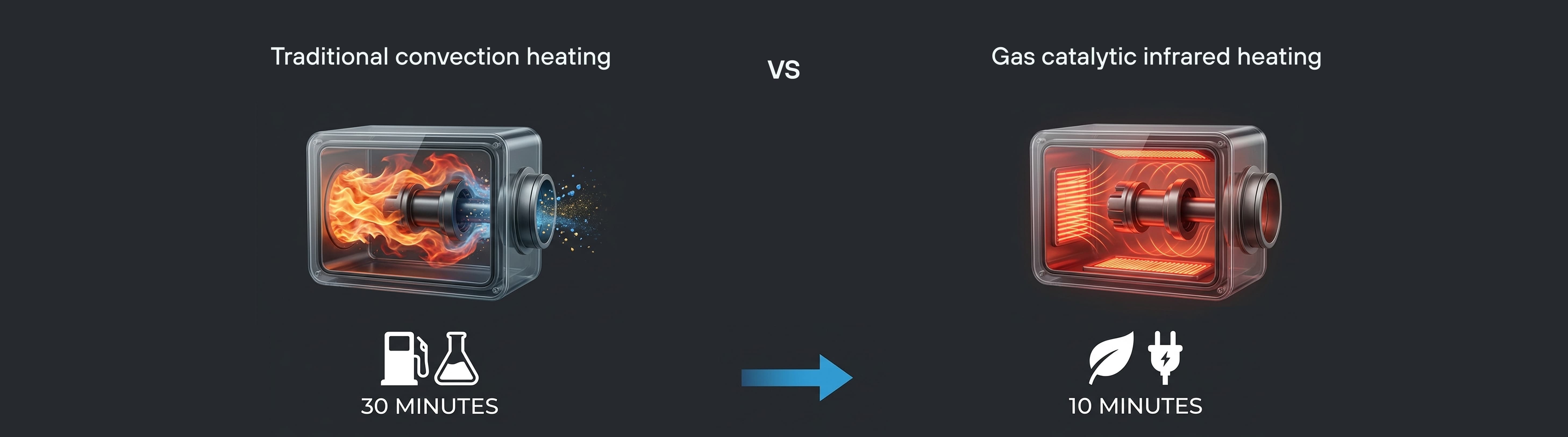
This fundamental shift in energy delivery underlies the observed acceleration of polymerization and improved finish quality. Physically, infrared heating is a form of radiant heat transfer, in which the energy of long-wavelength electromagnetic waves is absorbed by the molecular bonds of organic materials. Spectroscopy studies show that functional groups characteristic of polyester, epoxy, and acrylic powders exhibit pronounced absorption bands in the infrared region of the spectrum. This means that the energy of the infrared radiation is converted into thermal motion directly within the polymer matrix, bypassing the heating of the surrounding gaseous medium. As a result, heating becomes not only faster, but also more targeted. The contrast with convection ovens is crucial here. In a traditional system, air is heated, which then transfers heat to the part’s surface through convection and conduction. This process inevitably results in significant heat loss, high inertia, and an uneven temperature profile, especially when coating complex geometries. Metal with high heat capacity and thermal conductivity requires a long time to reach the set temperature, and coating temperature control is achieved indirectly through air temperature control, which reduces the precision of process control. Infrared heating eliminates this intermediate step. Energy is delivered directly to the zone where it is needed to activate the chemical polymerization reactions. This mechanism underlies the empirically proven “3:1 rule,” widely discussed in the engineering community: processes that require approximately 30 minutes in a convection oven are completed in 10 minutes under the influence of IR radiation. It’s important to emphasize that this isn’t about forced overheating, but rather about more efficient energy use, where the reaction rate is determined not by air temperature, but by the energy density absorbed in the polymer system. From a chemical kinetics perspective, the acceleration of the process is due to the fact that infrared radiation increases the local mobility of polymer chains and functional groups precisely at the moment and location of the reaction initiation. This reduces the induction phase of polymerization and ensures more synchronous melting and crosslinking processes. As a result, the formation of a three-dimensional polymer network occurs faster and more uniformly, which positively impacts the mechanical and barrier properties of the coating. Equally significant is the impact of infrared heating on the cleanliness and visual quality of the finish. In convection ovens, maintaining the correct temperature requires intensive air circulation, which creates turbulent air flows. These flows inevitably stir up dust particles, fibers, and microcontaminants, which settle on the uncured coating surface. For standard industrial applications, this effect may be acceptable; however, in the high-gloss and clear coatings segment, it becomes a critical factor in defects. Infrared ovens, on the other hand, operate with minimal or no air circulation. Radiant energy does not require a transport medium, meaning there are no turbulent flows that could transport contaminants. This creates conditions close to a laminar or quasi-static air environment, which is essential for the formation of Class A coatings with a high DOI and a mirror-like surface. Experience confirms that, with identical formulations and surface preparation, IR polymerization exhibits a significantly lower incidence of inclusions and optical defects.
Of particular interest is the ability to achieve zonal energy control, which is virtually impossible in traditional convection systems. Infrared panels can be configured to create non-uniform thermal fields tailored to the product’s geometry. This is fundamental for painting complex parts, where different areas have different mass-es, thermal conductivities, and spatial orientations. In a convection oven, these differences are smoothed out through long heating times, but this inevitably leads to energy overuse and overheating of less massive areas. An infrared system offers a fundamentally different approach. Radiation density can be increased in areas of sharp edges, stiffeners, and hard-to-reach areas where coating thickness is traditionally insufficient. This compensates for the Faraday effect and ensures uniform powder melting across the entire surface of the part. A key role here is played by the IR preheat-ing stage, often referred to as gelation, which occurs at the entrance to the main furnace. During gelation, the powder almost instantly transitions from a solid to a viscous-plastic state, forming a continuous film and becoming securely fixed to the surface. This occurs even before air movement or mechanical vibrations can affect the material’s distribution. As a result, the powder adheres even to sharp corners and vertical surfaces, where under traditional conditions it would tend to slide or blow away. This effect is directly related to corrosion resistance, as corners and edges are the most vulnerable areas to subfilm corrosion. For coating durability, uniformity of thickness at the edges is critical. Corrosion behavior studies show that even a slight reduction in the protective layer thickness at the corners can lead to accelerated degradation of the entire system. Infrared thermal optimization eliminates this structural defect during the polymerization stage, making it not only a productivity enhancer but also a factor in extending the life of the product.
The environmental aspect of gas catalytic IR heating also deserves special attention. Catalytic panels ensure virtu-ally complete gas combustion at a low flame temperature, significantly reducing nitrogen oxide and carbon monoxide emissions. Combined with reduced polymerization time, this leads to lower specific CO₂ emissions per unit of output. In an environment of increasingly stringent environmental regulations and the growing importance of ESG indicators, this factor is becoming an important argument in favor of switching to infrared technologies. 1Thirty Holding’s R&D practice views infrared heating not as a replacement for pure convection, but as an element of a hybrid thermal architecture. The combination of IR preheating zones with optimized convection modules allows for a balance between process speed, uniformity, and controllability. This approach is particularly effective when working with modern low-bake and low-cure powder coating systems, where temperature profile accuracy is critical. It’s important to note that implementing infrared technology requires a rethinking of the entire paint line design logic. Not only the heat source changes, but also the process control strategy, temperature control methods, and quality approaches. However, this is precisely its key advantage: it allows for a shift beyond the inertial convection paradigm and toward a more precise, adaptive, and energy-efficient polymerization model. In a broader context, gas catalytic infrared heating can be seen as part of the coatings industry’s overall transition to physically based, targeted methods of material manipulation. Instead of heating the entire medium, the industry is moving toward energy management at the surface and molecular bond level. This approach not only improves efficiency but also opens up opportunities for further integration of powder coatings with low-temperature systems, sensitive substrates, and complex multi-material structures.
Thus, thermal optimization using gas catalytic infrared heating is no longer a proprietary engineering solution but is becoming an essential element of the new physics of polymerization. It changes the understanding of process speed, quality, and sustainability, forming the foundation for the next stage of powder coating evolution, in which energy, chemistry, and product geometry are combined into a single, controllable system.