

Curing Below 140°C as a Strategic Shift in the Protective Systems Industry
In the history of powder coatings, there have been technological milestones that have changed not only the formulation of the material but also the very logic of its application. The transition from solution-based to powder-based systems was a turning point, defining the environmental and economic direction of the industry for decades to come. Today, the industry is facing a similarly large-scale shift associated with the advent of powder coatings capable of fully curing at temperatures below 140°C. This is not a matter of localized improvements in energy efficiency, but a fundamental redefinition of the applicability of powder coating technology in modern industrial conditions.
The importance of low-temperature powder coatings is determined by several macrotrends simultaneously exerting pressure on manufacturers and end consumers. Rising energy costs, stricter environmental regulations, the development of multi-material structures, and the increasing complexity of production chains are making the traditional 180–200°C temperature profile increasingly unsuitable. More and more products include temperature-sensitive components, whether polymer seals, electronics, composite components, or pre-lubricated assemblies. Under these conditions, high curing temperatures cease to be simply a process parameter and become a limiting factor for design and engineering solutions. This is why powder coatings with cur-ing temperatures below 140°C are now viewed not as a niche solution, but as a key to expanding the very philosophy of powder coating. They open the possibility of integrating coatings into earlier assembly stages, reduce the energy and carbon footprint of production, and make powder coating technology compatible with products that were previously automatically excluded from this segment. In this context, low-bake systems become the link between polymer chemistry, production energy, and industrial design. In recent years, research and development at 1Thirty Holding’s R&D centers have focused on precisely this area—the creation of powder coatings capable of forming a fully functional protective and decorative film at temperatures previously considered unattainable for thermoset systems. The key principle here is the absence of compromise: lower temperatures should not be accompanied by a loss of adhesion, mechanical strength, chemical resistance, or durability under real-world operating conditions.
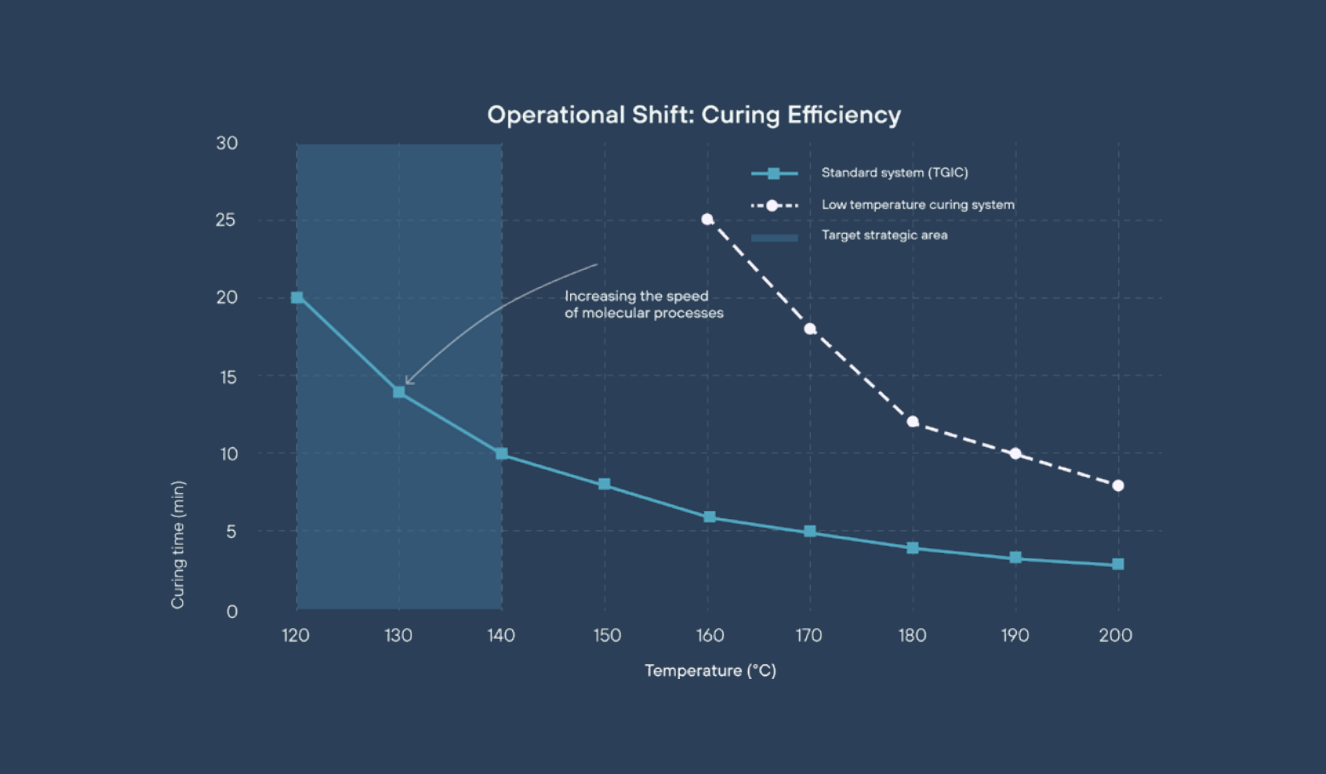
From a fundamental chemistry perspective, the main challenge of low-bake coatings lies in controlling the polymerization kinetics. Classic powder systems were designed based on the need to overcome the energy barrier associated with the limited mobility of macromolecules in the solid phase. Until temperatures reach approximately 170–180°C, polymer chains remain in a state where the probability of effective interaction between functional groups is low. Attempts to simply “lower the temperature” without changing the molecular architecture lead to incomplete crosslinking and degradation of properties, which has led to skepticism about low-temperature solutions for many years.
Modern low-bake systems operating below 140°C are based on a fundamentally different logic. They are designed from the ground up to provide increased reactivity of the polymer matrix. This is achieved through precise tuning of the resin molecular weight, the distribution of functional groups, and the glass transition temperature, which is shifted to a range that ensures sufficient segmental mobility already at 120–130°C. As a result, the melting process and the onset of the chemical reaction virtually coincide in time, radically shortening the induction phase of polymerization. Hardeners and catalytic components are particularly important in such systems.
Their purpose is not simply to accelerate the reaction, but to create a controlled reaction window in which crosslinking occurs intensively without the risk of localized overheating or uneven structure. From a physical chemistry perspective, this allows for a scenario in which the final crosslink density is comparable to traditional coatings, despite the significantly lower process temperature. Thus, temperature ceases to be a determining factor in quality, giving way to precision molecular engineering.
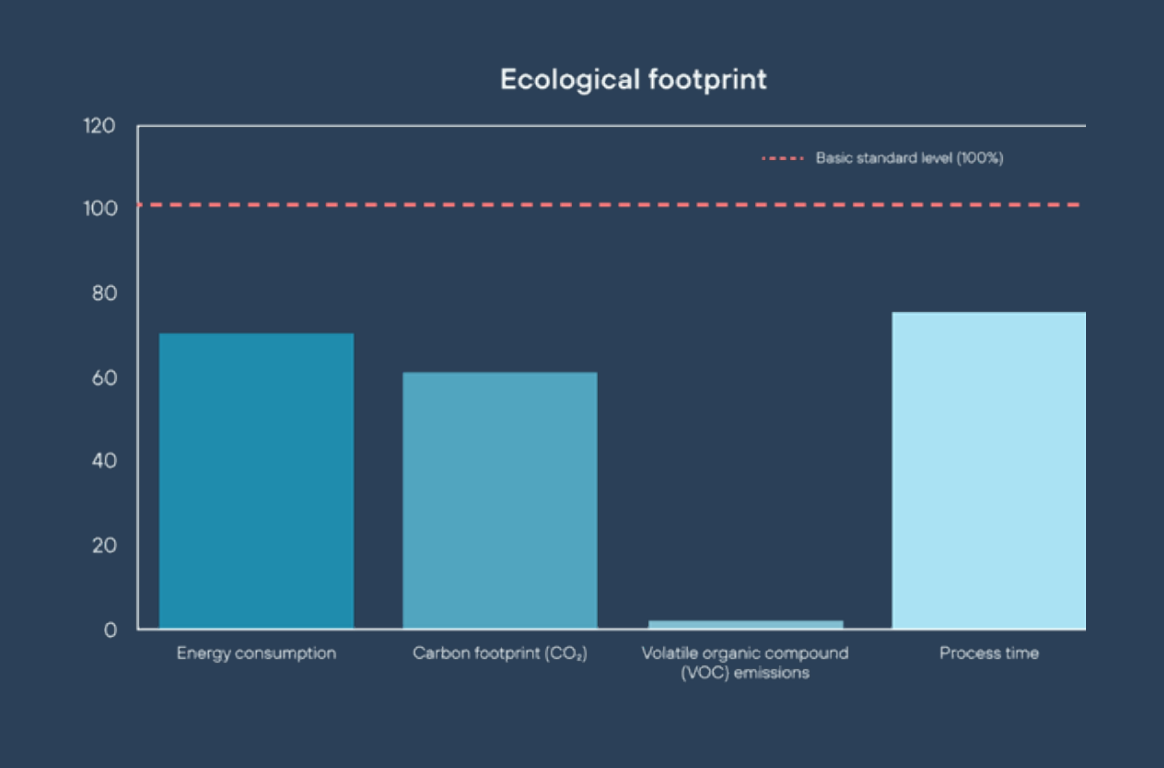
The industrial effect of such coatings becomes particularly evident when analyzing the thermal balance of paint lines. In real-world conditions, the majority of energy is spent not on polymerizing the coating itself, but on heating the massive metal parts and maintaining the oven temperature. Reducing the polymerization temperature by 50–60°C leads to a disproportionately greater reduction in energy consumption due to the reduced thermal inertia of the system. In addition to direct savings, this reduces line ramp-up time and increases its flexibility when changing product mixes. Low-temperature powder coatings below 140°C also significantly change the approach to product design. The ability to coat assemblies without dismantling heat-sensitive components opens up new architectural and engineering solutions. This is especially relevant for the electrical industry, transport engineering, and architectural systems, where the requirements for integrating various materials are constantly increasing. In these segments, low-bake coatings are becoming not just an alternative, but a determining factor in product competitiveness. From an aesthetic perspective, a gentler temperature profile has a positive effect on coating surface formation. Reduced thermal stress reduces the risk of microdefects associated with uneven melting and rapid cooling. The surface develops more uniformly, which is especially important when using transparent or translucent topcoats. Combined with modern powder coating chemistry, this allows for visual characteristics previously associated primarily with high-quality liquid systems.
It is important to emphasize that the durability of such coatings is determined not by the curing temperature, but by the quality of the formed polymer network. Modern testing shows that properly designed low-bake systems exhibit high resistance to corrosion, UV radiation, and chemical attack, confirming the fundamental principle: the decisive factor is the effectiveness of molecular interactions, not the absolute temperature.
As the share of renewable energy grows and carbon regulations become more stringent, manufacturers will increasingly evaluate coatings not only by technical performance but also by their energy and climate profile. Low-bake systems offer a clear advantage in this regard, allowing for a reduction in carbon footprint without abandoning powder coating technology. Over the next 5-10 years, we can expect a shift in industry standards, with the temperature range of 180–200°C no longer dominant. It will remain in place for certain segments, but will no longer define the market “norm.” Instead, a multi-layer coatings ecosystem will emerge, where the temperature profile will become a design parameter equal to color, texture, or gloss level. Equipment, chemical, and end-use manufacturers will increasingly integrate their developments, focusing on the compatibility of materials and processes.
In the longer term, low-bake powder coatings could become a catalyst for the transition to hybrid production lines combining powder coating with sensitive electronics, composites, and functional surfaces. This will lead to the expansion of powder coating technology into segments where it was previously virtually unused, and will establish a new standard for industrial coating based on precision molecular engineering, energy efficiency, and environmental responsibility. Thus, polymerization below 140°C ceases to be simply a technical achievement and becomes a marker for the next stage in the evolution of powder coatings. This stage is determined not only by the chemistry of the materials, but also by a shift in the very logic of industrial production, where temperature is transformed from a limiting factor into a manageable tool for the industry’s strategic development.
In a broader market context, the emergence of powder coatings with curing temperatures below 140°C marks the beginning of a structural shift in the industry.